 Tarotsmith
 Tarotsmith Shadow Alchemy
 Tarotsmith Horoscopes



Relationship Spread #1

Difficulty: Easy
This tarot spread is easy to read, like a convenient chart. In this spread, court cards generally indicate actual people with the same characteristics. Knights (or corresponding princes, but not kings) and queens are meant to represent actual men and women in this tarot spread. Look for patterns in the cards as always.
Card #1 is the overall significator of the relationship. The two columns on either side of the significator characterise each individual's role in the relationship. The relationship does not have to be romantic. In fact, it could be a relationship between a person and a group, or even how two groups relate.
The top row, cards #7 & #2, is about the conscious thoughts of each person, or what they think about the relationship and likewise how they view their partner.
The middle row, cards #6 & #3, reveals the way each individual feels about the other. Emotional awareness corresponds to a person's unconscious thoughts that run deep, affecting a person in ways he or she is not fully aware of.
The bottom row, cards #5 & #4, represents the way each person behaves, in other words the stance taken regarding the relationship. The way a person acts may be genuine, but sometimes people are phony and manipulative, so it is best to weigh this card against the other person's cards to determine how they match up.
Your Relationship #1 Reading
| You | Other Person | ||
| Thought |  Eight of Swords |
 XIV – Temperance |
|
| Emotion |  Two of Wands |
The Significator Ten of Cups |
 Three of Wands |
| External Stance | 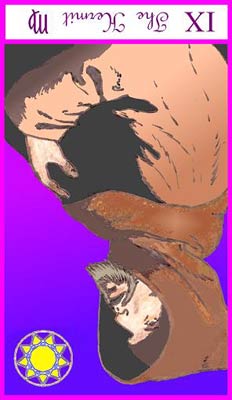 IX – The Hermit |
 XIII – Death |
The Significator
Ten of Cups
A good situation is disrupted. The end of a good time in life. Family problems or disruptions in your home life. Having an overly idealistic view of what a relationship should be like. Happiness that proves to be as fleeting as a rainbow. An unhappy childhood or a dysfunctional family life.
The Querent's Thoughts
Eight of Swords
Self-imposed limitations. Feeling powerless in a situation. Having a victim mentality. 'Paralysis of analysis' (i.e., lack of progress due to over analysing something). Inability to understand your situation or to communicate it clearly to others. A need to understand your concerns, reservations, or fears in order to conquer them. Being hampered by blind faith in something. Not seeing 'the forest for the trees'.
The Other Person's Thoughts
XIV – Temperance
Inflexibility causes problems in resolving issues. An inability to be open to others' viewpoints or to find a middle ground or compromise in a troublesome situation. Taking extreme measures when a more balance approach is required. Adhering to either extreme of abstinence or self-indulgence.
The Querent's Emotions
Two of Wands
An enterprise is faltering due to infighting. An intractable conflict where neither side is willing to budge an inch. An unfair fight. The need to achieve self-mastery before you can gain the upper hand in a conflict.
The Other Person's Emotions
Three of Wands
An enterprise that looked promising fails to deliver. Short-sightedness, unrealistic plans, or overconfidence cause problems for a new venture. The road ahead seems filled with roadblocks. A need to expand your horizons. Getting bogged down in details and losing the 'big picture'.
The Querent's External Stance
IX – The Hermit
Someone has been too withdrawn, antisocial, or introverted and would benefit from the company of others. Loneliness or aloofness. Isolation from people who might provide help or useful guidance. Feeling ostracised, left out.
The Other Person's External Stance
XIII – Death
Experiencing a dramatic or significant change in your life. A realisation that there is no turning back; a bell can't be un-rung. A time to discard whatever is not adding to your life. When one door closes, another will open. Taking 'down time' that is necessary for renewal, new growth, and transformation. Dealing with issues regarding death and dying.