 Tarotsmith
 Tarotsmith Shadow Alchemy
 Tarotsmith Horoscopes

Path Spread
Difficulty: Easy
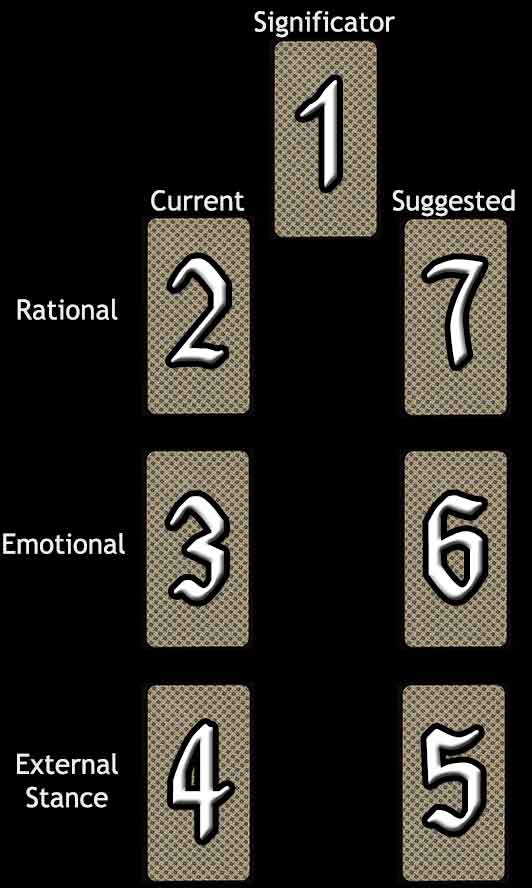
For the Path reading, one asks for suggestions how to behave properly to achieve a desired result. The Current column represents how the reader has been acting, and the Suggestedcolumn suggests how they should act to achieve a certain goal. The chart-like spread uses the standard three levels: Rational, Emotional, and External Stance (how one projects oneself outwardly). When comparing the Current and Suggested cards, the most important thing is to notice the differences between the two cards. It is these differences which hint at the behaviours that should be altered.
Card #1 is the significator, the card which should reflect the nature of the query and/or the desired outcome.
Card #2 shows the way the reader is and has been thinking. Card #7 suggests how to change the way one thinks to serve themselves better.
Card #3 suggests the reader's emotional attitude. Though it may seem difficult to manipulate one's own emotions, it can be done if one puts their mind to it. For example, acting a certain way such as smiling intently for a few minutes will lead the emotions to follow. When a person tries this, as silly as the exercise seems, they find this to evoke the emotion of happiness. For this reading, one should try to make themselves feel the way that Card #6 suggests.
External Stance means how one acts outwardly, how they hope others see them. Card #4 is about how the reader has been acting, while #5 indicates how they should act outwardly, for other people's sake. It is the differences between these cards that hint at what behaviour patterns should be altered.
Your Path Reading
| Current | The Significator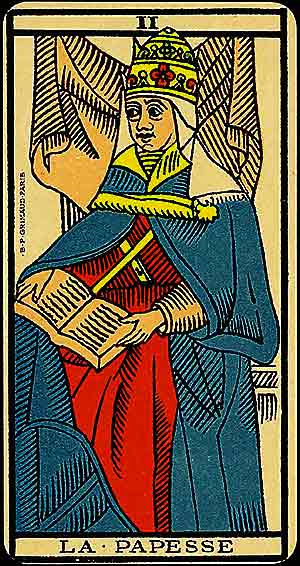 The High Priestess (La Papesse) |
Suggested | |
| Thought | 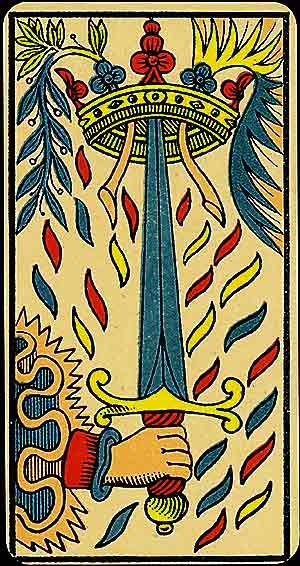 Ace of Swords |
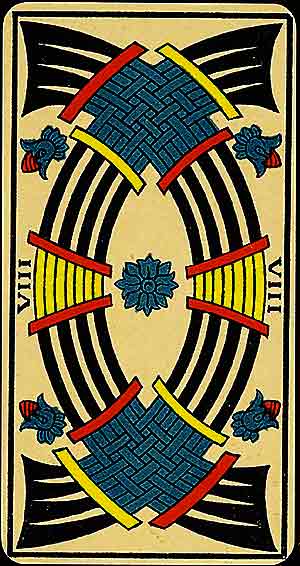 Eight of Swords |
|
| Emotion | 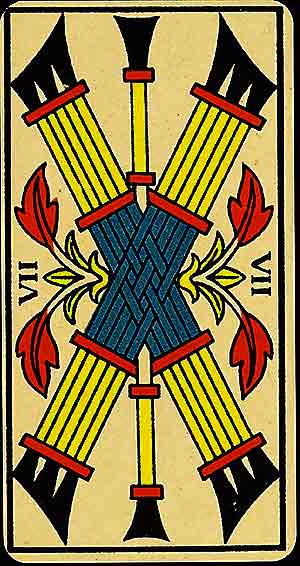 Seven of Batons |
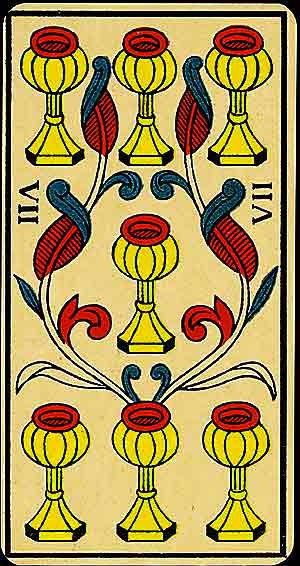 Seven of Cups |
|
| External Stance | 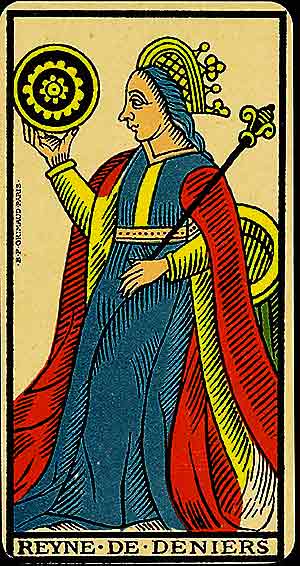 Queen of Coins |
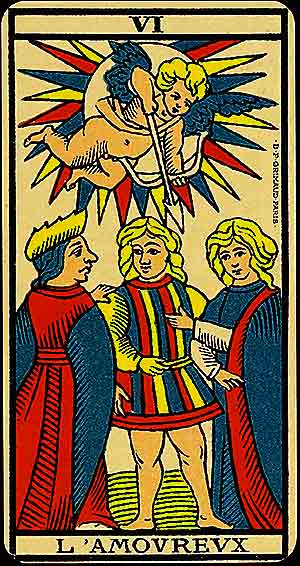 The Lovers (L'Amoureux) |
The Significator
The High Priestess
(La Papesse)
Symbolism:
The High Priestess is shown seated, holding an open book, signifying hidden knowledge and mysteries. She is flanked by two pillars (sometimes black and white), representing duality and balance. Her veil hints at the separation between the conscious and subconscious. Her serene expression reflects her mastery of the inner world and her connection to divine intuition.
Meaning:
The High Priestess embodies mystery, wisdom, and the power of intuition. She encourages stillness and reflection, guiding you to trust your inner voice over external noise. This card often appears when something hidden needs to be uncovered, whether it's a secret, a truth, or a deeper understanding of oneself.
In relationships, the High Priestess may suggest emotional depth or hidden dynamics. Spiritually, she symbolises the gateway to higher knowledge, urging you to explore the realms of dreams and symbols to uncover your truth.
Keywords:
Intuition, mystery, inner wisdom, reflection, subconscious, hidden knowledge, spirituality, patience, introspection, stillness.
Current Thoughts
Ace of Swords
Symbolism:
A single, upright sword dominates the design, often crowned with laurels or floral motifs, symbolising clarity and power. This card evokes themes of mental focus, decisive action, and the emergence of truth.
Meaning:
The Ace of Swords signifies a breakthrough, clarity of thought, or the beginning of intellectual endeavours. It heralds a new phase where truth, logic, and reason will guide your actions. This card encourages decisiveness, honesty, and a commitment to facing challenges with integrity.
In relationships, it may suggest open communication or a new understanding. Spiritually, it represents cutting through illusions to achieve enlightenment.
Keywords:
Clarity, breakthrough, truth, mental focus, logic, decisiveness, honesty, intellectual pursuit, triumph, communication.
Suggested Thoughts
Eight of Swords
Symbolism:
Eight swords form a restrictive and intricate pattern, evoking a sense of entrapment or limitation. The imagery reflects mental constraints, self-imposed boundaries, and the need for clarity to break free.
Meaning:
The Eight of Swords symbolises mental entrapment, self-doubt, or feeling stuck. It suggests that limitations are often self-imposed and can be overcome with clarity and courage. This card encourages you to reclaim your power and break free.
In relationships, it may reflect feelings of being trapped or misunderstood. Spiritually, it invites introspection to break free from limiting beliefs.
Keywords:
Restriction, self-doubt, entrapment, mental barriers, fear, powerlessness, clarity, courage, breaking free, introspection.
Current Emotions
Seven of Batons
Symbolism:
Seven batons intersect in a slightly irregular pattern, with fresh leaves sprouting at their joints, suggesting perseverance amidst challenges. The imagery conveys determination, resilience, and the courage to stand one's ground.
Meaning:
The Seven of Batons represents defending your position, standing firm against opposition, and asserting yourself amidst challenges. It emphasises courage and persistence in maintaining your beliefs or goals, even when faced with adversity. This card highlights the importance of self-confidence and holding your ground.
In relationships, it can indicate overcoming external pressures or standing together in unity. Spiritually, it reflects the need to remain steadfast on your path despite doubts or criticism.
Keywords:
Defiance, resilience, courage, perseverance, self-defence, opposition, determination, conviction, assertiveness, strength.
Suggested Emotions
Seven of Cups
Symbolism:
Seven cups are arranged in an intricate and slightly asymmetrical pattern, surrounded by flourishing floral designs, hinting at dreams and desires. The card represents choices, imagination, and the allure of possibilities, some of which may be illusory.
Meaning:
The Seven of Cups represents imagination, options, and the challenge of discerning between reality and illusion. It signifies the allure of possibilities and warns against becoming overwhelmed by fantasies or unrealistic expectations.
In relationships, it suggests idealisation or confusion about choices. Spiritually, it reflects the need to ground your aspirations in practicality while staying connected to your vision.
Keywords:
Imagination, options, illusion, temptation, choice, fantasy, dreams, discernment, creativity, vision.
Current External Stance
Queen of Coins
Symbolism:
The Reyne of Coins is seated gracefully, holding up a coin. This card symbolises nurturing energy, material comfort, and the ability to create and maintain prosperity in practical and emotional realms.
Meaning:
The Queen of Coins symbolises abundance, nurturing, and practicality. She reflects the ability to balance material success with care for others, often in a domestic or family setting. This card speaks to the importance of creating a nurturing environment where both material and emotional needs are met.
In relationships, it signifies a partner who is caring, practical, and deeply grounded. Spiritually, it represents the abundance that flows from a nurturing, balanced life and the wisdom that comes from caring for one's surroundings.
Keywords:
Nurturing, abundance, practicality, balance, wealth, comfort, family, responsibility, grounded, care.
Suggested External Stance
The Lovers
(L'Amoureux)
Symbolism:
The Lovers card depicts a man standing between two women, with Cupid above aiming an arrow. The scene suggests a choice or a union, with the women often representing opposing influences. In some interpretations, the figures are Adam and Eve, symbolising the duality of earthly and spiritual love.
Meaning:
The Lovers represent connection, harmony, and the power of choice. This card speaks to deep relationships, whether romantic or platonic, and the alignment of values and goals. However, it also highlights the necessity of making meaningful decisions, often at a crossroads where the heart and mind must collaborate.
In relationships, the Lovers symbolise love, commitment, and mutual respect. Spiritually, they encourage balancing the dualities within yourself and finding unity in diversity.
Keywords:
Love, harmony, connection, choice, duality, relationships, unity, attraction, alignment, crossroads.