 Tarotsmith
 Tarotsmith Shadow Alchemy
 Tarotsmith Horoscopes


Relationship Spread #2
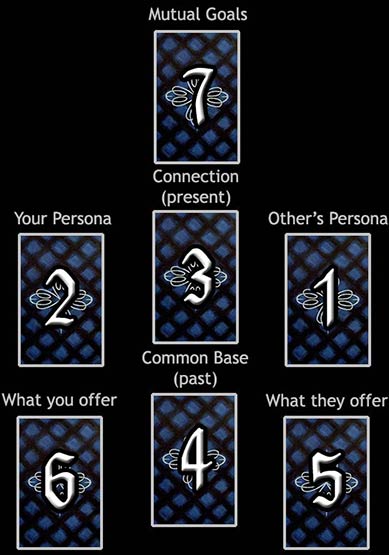
Difficulty: Easy
This relationship spread focuses more on the common ground of the relationship, with three cards in the middle column showing the common ground. The middle column essentially displays the past, present, and future of the relationship.
Card #4 stands for the common base of the relationship, which may be thought of as the past events which have shaped their characters, bringing them together. The current connection that binds them together is Card #3, indicating the values shared. Card #7 implies the common goals that would keep the pair together moving into the future.
The columns on either side show what each partner brings to the table. Remember, relationships need not be romantic, and the partners could even be groups rather than individuals. In this layout, the other person is on the left-hand side and the reader on the right.
Cards #1 & #2 indicate the separate personalities of each member of the relationship. These cards form a sort of bridge with the cards beneath them, #5 & #6, which show the qualities that each partner offers the other person, and thus to the relationship as a whole.
Your Relationship #2 Reading
Mutual Goals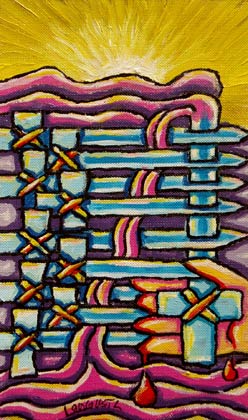 |
||
Your Qualities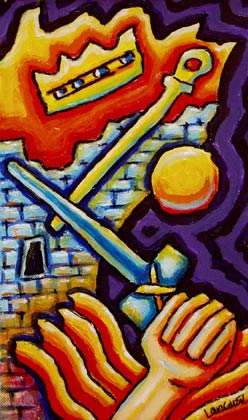 |
Connection (Present)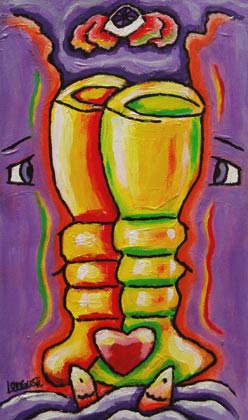 |
Others' Qualities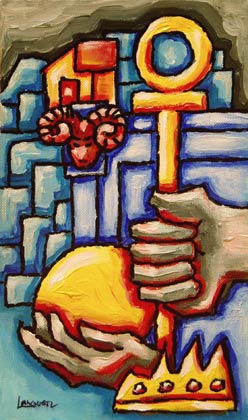 |
What You Bring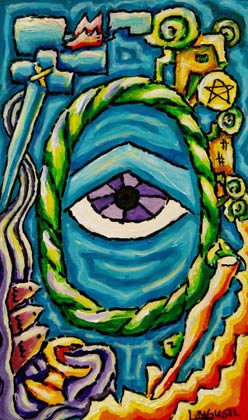 |
Common Base (Past)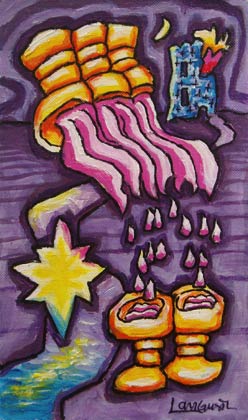 |
What They Bring 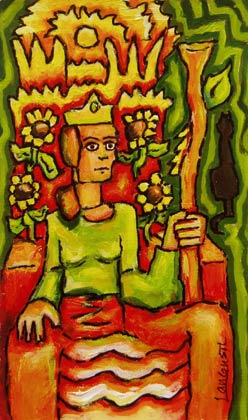 |
7: Mutual Goals
10 of Swords
Letting go of rationality is shown here as a dissolving process. Nine swords are cutting up a tenth sword, the point of which is melting and with this fluid wets the other nine swords.
The hand is injured by the four lower swords and is opening up; two drops of blood can be seen. It is not clear how many of the swords are or should be melting. The sun rising in the background brings with it new strength.
3: Connection
2 of Cups
The two faces and the two cups seem together to form an entirety. The difference between them is shown, among other things, through the colours, which, in each case, mirror the opposite.
Two fish in the water also suggest dualism in the unity. In the same way, the heart at the top, made of two parts, becomes one at the bottom. The suggestion of an angel above the heads supports the same theme.
4: Common Base
5 of Cups
Three cups are spilling their contents. The other two are collecting what is lost, suggesting that nothing can really be lost. Nevertheless, the spill is important so that a change can take place.
The tower and the star refer to the cards, which are following the devil, which is related to the five cups. The flames in the tower can be understood as a heart. If the observer turns round, he will take the path in the right direction and will not look back.
2: Your Qualities
The Tower
A small ray of light shines through a crack in the wall and arouses our yearning for freedom and knowledge. The prison walls burst open and we can escape. We have already taken hold of the sword which stands for differentiation, consciousness and independent thought.
The monarch's insignia of the Emperor shows we are prepared to reconquer the seat on our own throne.
1: Their Qualities
The Emperor
The picture has the effect of being rather poor and harsh. The blue colours represent coolness, but due to the red and yellow one can sense a certain energy, which also appears in Aries' head at the corner of the throne, connected astrologically with the Emperor.
The card's number four, which also represents the element earth, can be found in the house in the square of rocks and the crown also shows four spikes and four stones. Further symbols of the Emperor are an orb (symbol of world dominion) and a form of sceptre (symbol of materialism in life).
6: What You Bring
The World
5: What They Bring
Queen of Wands
The orangey-yellow colour of the picture symbolises fire; the green colour portrays fertility and growth. The sunflowers also testify a connection between energy and growth.
The throne gives the impression of a sun-queen; the creases on her skirt point to sexual energy, her red hair is tied back. The black cat, with its back to us, stands for independence and magic powers. There is a precious stone on the queen's crown, this connects her to the magician's figure one.