 Tarotsmith
 Tarotsmith Shadow Alchemy
 Tarotsmith Horoscopes


Path Spread
Difficulty: Easy
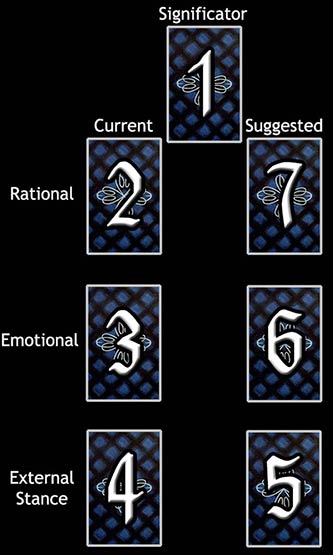
For the Path reading, one asks for suggestions how to behave properly to achieve a desired result. The Current column represents how the reader has been acting, and the Suggestedcolumn suggests how they should act to achieve a certain goal. The chart-like spread uses the standard three levels: Rational, Emotional, and External Stance (how one projects oneself outwardly). When comparing the Current and Suggested cards, the most important thing is to notice the differences between the two cards. It is these differences which hint at the behaviours that should be altered.
Card #1 is the significator, the card which should reflect the nature of the query and/or the desired outcome.
Card #2 shows the way the reader is and has been thinking. Card #7 suggests how to change the way one thinks to serve themselves better.
Card #3 suggests the reader's emotional attitude. Though it may seem difficult to manipulate one's own emotions, it can be done if one puts their mind to it. For example, acting a certain way such as smiling intently for a few minutes will lead the emotions to follow. When a person tries this, as silly as the exercise seems, they find this to evoke the emotion of happiness. For this reading, one should try to make themselves feel the way that Card #6 suggests.
External Stance means how one acts outwardly, how they hope others see them. Card #4 is about how the reader has been acting, while #5 indicates how they should act outwardly, for other people's sake. It is the differences between these cards that hint at what behaviour patterns should be altered.
Your Path Reading
| Current | The Significator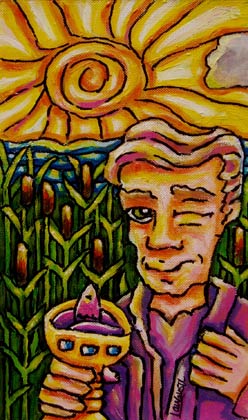 Prince of Cups |
Suggested | |
| Thought | 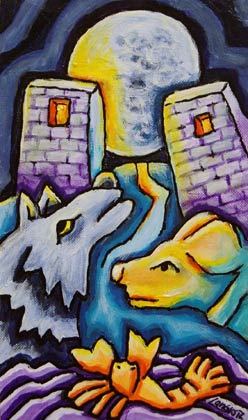 The Moon |
 The Lovers |
|
| Emotion | 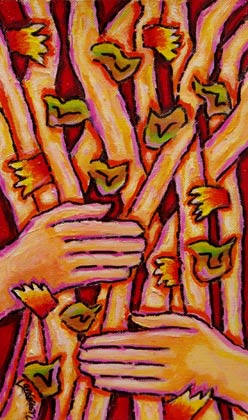 10 of Wands |
 Temperance |
|
| External Stance | 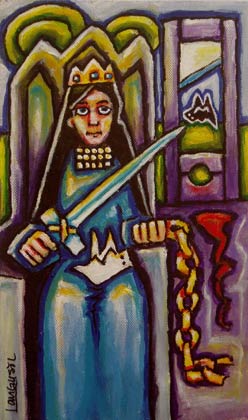 Queen of Swords |
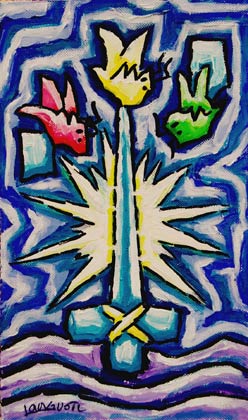 Ace of Swords |
The Significator
Prince of Cups
By winking, the prince is trying to make the marshy spot more attractive for a bathe. The content of his cup doesn't look like water. The sun brightens the scene, although the first cloud has already appeared.
Current Thoughts
The Moon
This illustration, as with the previous ones, is based on classical examples. The moon can be seen foreshadowing its warmer and brighter side. Both towers, right and left of the path, are an indication of the Holy Jerusalem. The violet colour promises spiritual experience. To reach them the path leads past the wolf, which symbolises danger. The protecting force is portrayed by the dog, which appears lighter.
The crab, which is coming out of the water, describes the appearance out of the depths and the return to light. The crab also symbolises a character which has developed a strong contact to its emotions and intuition. Because of this it is very vulnerable and protects itself with armour and usually an extra covering.
Suggested Thoughts
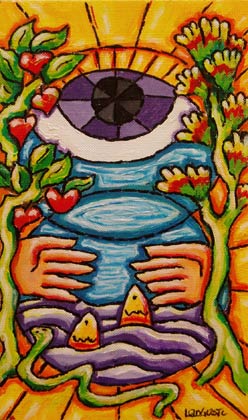
The Lovers
The picture shows the connection with the opposite theme represented by two circles (blue = conscious) which combine to form an oval. The oval represents striving for unity on a higher level. The two hands stand for polarity and the confrontation with the tree of eternity and the tree of knowledge (of good and evil) with heart-shaped fruit. The serpent is coiled up at the foot of the tree of knowledge.
The yellow background emphasises the energy of the moment. Fish and water show the duality again and the produced flow of energy. The archangel Raphael watches over everyone with his blessing, indicated by God's eye.
Current Emotions
10 of Wands
The intensity of the Nine of Wands diminishes in the Ten of Wands. The colours are paler; it seems more difficult to hold the wands together; at the same time the small flames are burning both hands, the leaves are beginning to wither.
Suggested Emotions
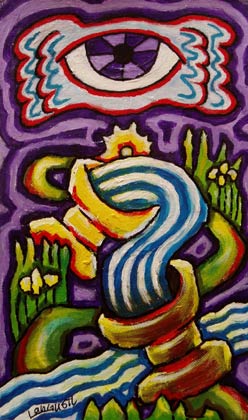
Temperance
The path through the underworld can be seen which eventually leads into light. The path is edged with lilies, the underworld flowers. The abstract archangel Michael is helping to find the right composition for the flow of energy, in other words is on the way through the subconscious (forgotten) to keep a minimal contact going with the conscious e.g., by transmission (documents...)
Current External Stance
Queen of Swords
The queen is holding the butterfly carefully on her lap. At the same time, she is showing the detached chain and is banishing the black butterfly to the guillotine.
The blood on the ground shows clearly that the apparatus has already been used. She does not look callous; instead, she looks grievous and resolute. Her collar, studded with 15 precious stones, indicates she is sometimes struck dumb by little devils, the result of painful experiences.
Suggested External Stance
Ace of Swords
The sword is rising out of the water. The blue colour in the picture symbolises clarity. The three different coloured butterflies indicate different thoughts and the perception of difference. One butterfly is sitting on the tip of the sword, a symbol of decision. The halo supports the impression of clarification and purification.