 Tarotsmith
 Tarotsmith Shadow Alchemy
 Tarotsmith Horoscopes

Decision Spread
Difficulty: Easy
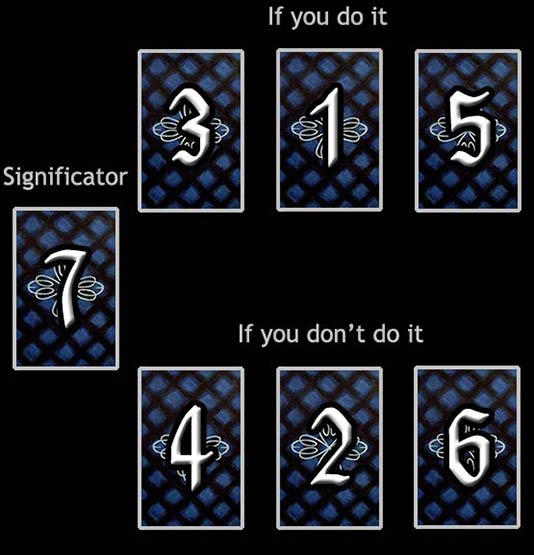
This simple but highly useful spread calls for a question to be asked in this format:
'What happens if I do (X), and what happens if I do not do (X)?'
Please note that it should not be viewed as a decision between two different options, but about whether a single option should be exercised or not. A second option would call for a separate reading.
Card #7 is the significator, the overall theme of the query.
Cards #3, #1, & #5 represent the chronological sequence of events that occurs if the reader chooses to do (X).
Cards #4, #2, & #6 represent the chronological sequence of events that unfolds if the reader chooses not to do (X).
Your Decision Reading
The Significator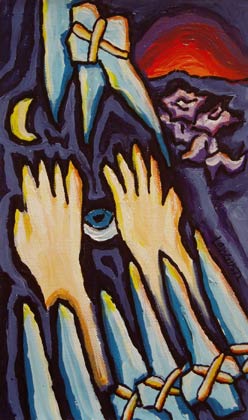 9 of Swords |
Outcome if you do it: | ||
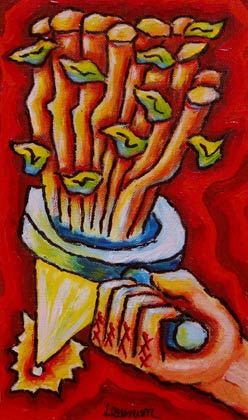 9 of Wands |
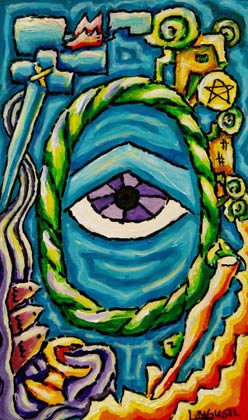 The World |
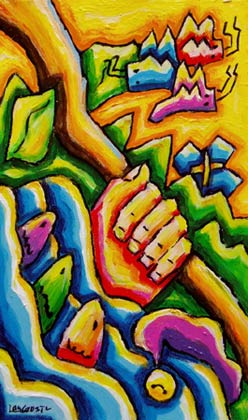 The Fool |
|
| Outcome if you don't do it: | |||
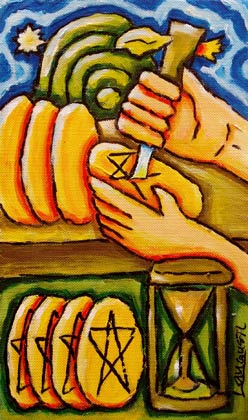 8 of Coins |
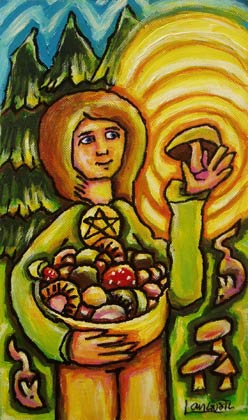 Princess of Coins |
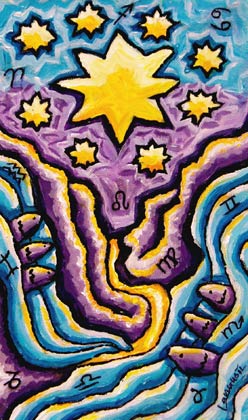 The Star |
|
9 of Swords
The swords look like teeth, which at any moment could bite. The hands are held up for protection. The eye wants to open, but its vision is obstructed.
The waning moon emphasises the existing fear. The sunrise is at hand. Roses promise development, joy of life and the coming forth of emotions in the near future.
Outcome if you do it:
9 of Wands
The powerful energy in this situation is emphasised by the intensive colour red in the background. The wands are moving onwards through a magnifying-glass, which bundles up the strength into one item. The blue colour of the magnifying-glass points to conscious action.
Scratches can be seen on the fingers of the hand, which, due to lack of concentration or coordination, come into contact with their own energy and have been recognised on previous cards.
The World
The eye is the same as that on the Magician's card, but the wish to develop is not portrayed any more. The oval wreath suggests the unification of polarities, as with the Lovers, but here the unification actually takes place.
The symbols for the four elements are collected around the oval and are reconcilably united together. The blue colour of the background symbolises consciousness and clarity.
The Fool
The bright colours symbolise many possibilities. The Fool is holding the pilgrim's staff in his hand. Water and fish indicate openness and vivacity. The butterflies also indicate different ideas and a joy of living.
The golden yellow background gives the scene energy of life. One can see the tip of the Fool's cap. The cross, or rather the handle of the sword in the background, gives an awareness of danger, which is lurking along the path the Fool is going to take.
Outcome if you do not do it:
8 of Coins
Four pentacles are already completed and are standing under the table. They are the pentacles from the first four Pentacle cards.
The hour-glass shows that time is still needed for the work. The handle of the tool looks like a wand and indicates that, with the necessary commitment (small flame), success will slowly develop (leaf). The storm announces the future success.
Princess of Coins
The many different types of mushrooms fascinate the princess. Each one of them is like a precious stone. She collects everything she finds without considering what to do with them. As one can see, some of the mushrooms are poisonous. Her curiosity and openness can also be a danger to her.
She is in the country. The busy mice look like friends or brothers and sisters.
The Star
Nine stars are pointing towards a goal. The violet colour in the picture illustrates the spiritual atmosphere, the blue water and the fish symbolise clarity, flow of energy and liveliness, the path is well lit and seems to become easier and the sky is clearing to a light blue.
The signs of the Zodiac point towards methods, which are occupied with one's own future, and act as deputy for all oracle techniques.