 Tarotsmith
 Tarotsmith Shadow Alchemy
 Tarotsmith Horoscopes

Cross Spread
Difficulty: Easy
The Cross Spread is good for questions asking for advice. It can also be used to determine the meaning of a confusing card from a previous reading, or for that matter, to shed light on other points of confusion.
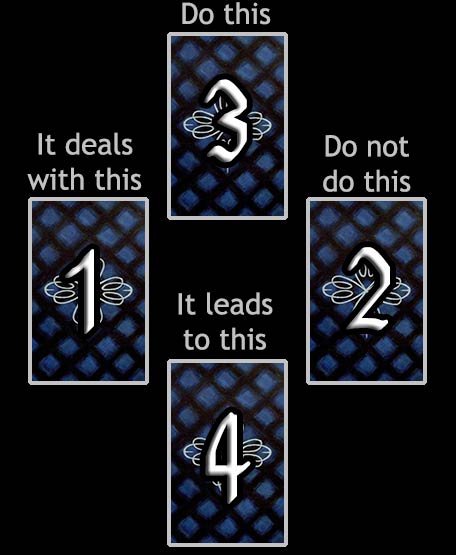
In questions asking advice, this tarot spread is self-explanatory. The main thing is to determine the difference between cards #2 and #3. #1 is the topic and #4 is the result.
In questions regarding confusion, such as: "What was the meaning of Card (X) in the last spread?" the main thing is also to determine the difference between cards #2 and #3. In this case, #2 will show what the card was not referring to, and Card #3 will show what was really meant. Card #1 is the topic and #4 represents the purpose it serves.
Your Cross Reading
DO This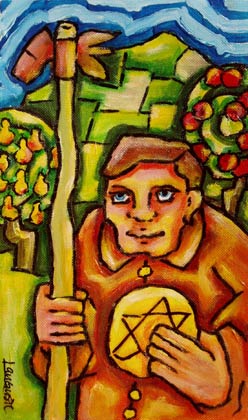 Prince of Coins |
||
It Deals with This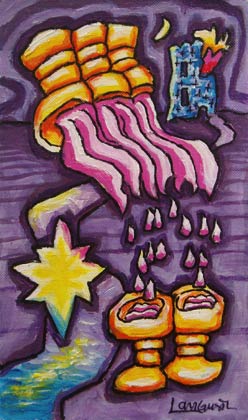 5 of Cups |
Do NOT Do This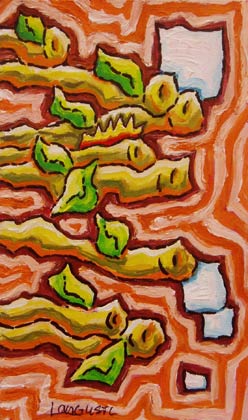 8 of Wands |
|
It Leads to This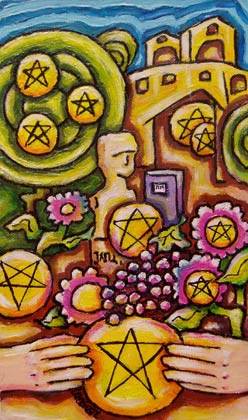 10 of Coins |
It Deals with This
5 of Cups
Three cups are spilling their contents. The other two are collecting what is lost, suggesting that nothing can really be lost. Nevertheless, the spill is important so that a change can take place.
The tower and the star refer to the cards, which are following the devil, which is related to the five cups. The flames in the tower can be understood as a heart. If the observer turns round, he will take the path in the right direction and will not look back.
Do NOT Do This
8 of Wands
The sketch quotes the picture from the Raider-Waite deck. Eight wands are flying through the air.
DO This
Prince of Coins
The fields and fruit trees are well kept and managed. Everything seems to be in order. The harvest is certain to turn out well. Apart from a few gold buttons, the prince does without any jewellery. His facial expression mirrors his pride in his performance, but at the same time a certain submissiveness.
It Leads to This
10 of Coins
The pentacles can be found inside and outside the town, as fruits on trees, as an exchange object, as a value which can bring us beauty, knowledge, nutrition or culture, by us exchanging these values, if necessary, with the help of payment (money).
The wise man knows that only by exchanging our goods amongst ourselves can we make a rich community. One pentacle shows an upside-down pentagram.