 Tarotsmith
 Tarotsmith Shadow Alchemy
 Tarotsmith Horoscopes

Blind Spot Spread
Difficulty: Varies
This tarot spread is used to enhance self-awareness. Questions about learning something about oneself or things that are hidden work very well with this tarot spread, although no question is necessary.
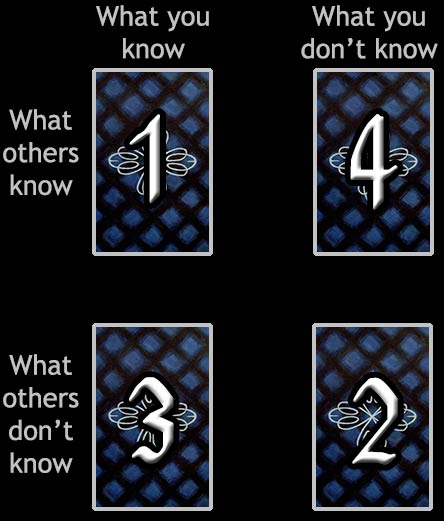
- This tarot card displays the obvious identity, the part of oneself that is consciously known and projected to others.
- This card indicates unconscious driving forces that neither the reader nor others are aware of about them, the great unknown. Nobody knows what this tarot card means, at least not yet...
- The part of oneself that is concealed, to keep others from discovering, is apparent in this card.
- This is the Blind Spot. This is what was asked about, that which this reading should bring awareness of. The reader may wish to pay close attention to these mannerisms.
Your Blind Spot Reading
| What you know | What you don't know | |
| What others know | 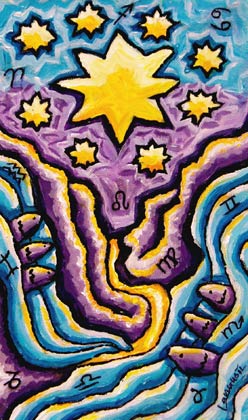 The Star |
 The Hierophant |
| What others don't know | 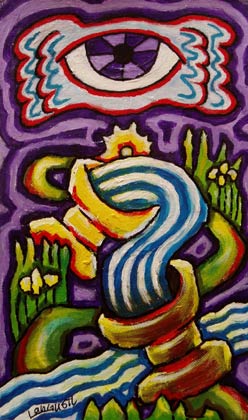 Temperance |
 The Magician |
This card displays your obvious identity, the part of you that everyone knows.
The Star
Nine stars are pointing towards a goal. The violet colour in the picture illustrates the spiritual atmosphere, the blue water and the fish symbolise clarity, flow of energy and liveliness, the path is well lit and seems to become easier and the sky is clearing to a light blue.
The signs of the Zodiac point towards methods, which are occupied with one's own future, and act as deputy for all oracle techniques.
This card shows unconscious driving forces that neither you nor your company is aware of about you. This is the Great Unknown.
The Magician
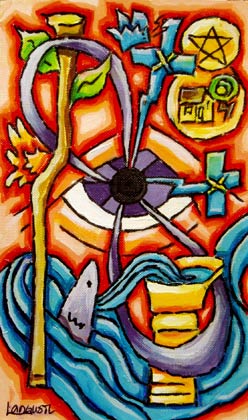
The symbols of all the elements are shown on the picture as possibilities. The eye, with its triangular shape, refers to the Holy Trinity. It seems as though it has just opened and one can recognise the spokes of the Wheel of Fortune in its iris.
The ribbon of eternity shows us how all possibilities can develop in waves out of the one item. The red background supports the energy of the illustration.
The secrets you keep from others are shown by this card.
Temperance
The path through the underworld can be seen which eventually leads into light. The path is edged with lilies, the underworld flowers. The abstract archangel Michael is helping to find the right composition for the flow of energy, in other words is on the way through the subconscious (forgotten) to keep a minimal contact going with the conscious e.g., by transmission (documents...)
This is your Blind Spot. This is what you asked about – what you wished to be made aware of by this reading.
The Hierophant
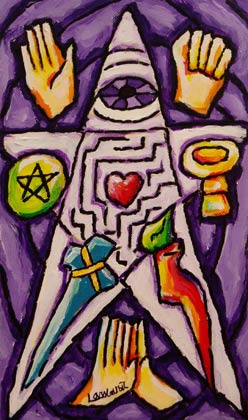
The pentahedral star in the picture shows how the four elements, which appear in the four lower rays, come into contact with spiritualism. This is represented in the uppermost point by God's eye, in the iris of which the Wheel of Fortune is alluded to. The violet background underlines the principle of spiritualism.
The labyrinth in the middle of the star points to the search for the meaning, which by way of the heart is also a search for the centre. The two hands at the top represent the obvious (exoteric) and the concealed (esoteric). The praying hands at the bottom symbolise the pupil.